Objectives
1—Sign up for Wasabi Cloud Sync Manager and sign in.
2—Enter credentials for cloud migration in WCSM.
3—Enter bucket information for cloud migration in WCSM.
Before Wasabi can initiate a data migration job, you must specify the source and target (Wasabi bucket) credentials required for migration in the WCSM Portal.
Entering Source Bucket Credentials
Click Credentials.
Click Create credentials.
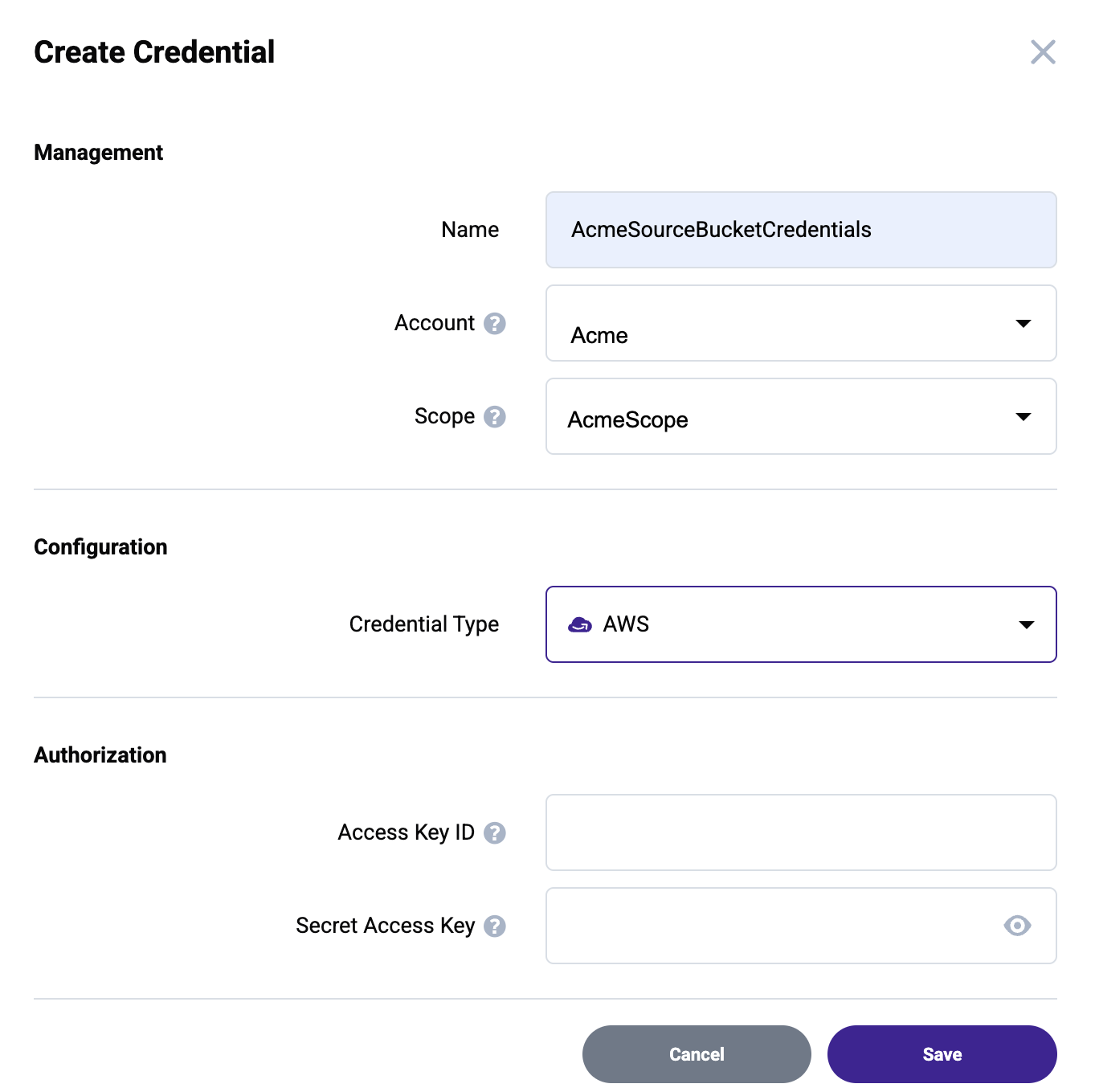
Enter the following information. For more information about each required field, click
 to view the available tooltips.
Name—Provide a unique name for the source bucket credential (for example, AcmeSourceBucketCredentials).
Account—Click the drop-down to select your WCSM account.
Scope—Click the drop-down to select the scope (the restricted access and role for a specific account).
Click the drop-down to select the Credential Type (the hyperscaler where your data resides).
Depending on the hyperscaler, the credentials required for authorization will vary. Provide the appropriate credentials. Once complete, continue to Step 6.
Click Save.
Continue to Entering Target Bucket Credentials.
Specifying Credentials for AWS and Wasabi
If you are migrating data from either AWS or Wasabi, enter the following credentials.
Access Key ID—Access key for the source bucket.
Secret Access Key—Secret key for the source bucket.
Specifying Credentials for Azure
The following information is required to specify credentials for Azure Blob storage in WCSM. Microsoft recommends transitioning away from Shared Key authorization for Azure Storage in favor of using Azure AD.
Click the drop-down to select a Type. Depending on the selected type, enter the appropriate information.
Client Certificate Credential
Tenant ID—The Directory (tenant) ID of the application representing WCSM in Azure AD.
Client ID—The application (client) ID of the application representing WCSM in Azure AD.
Certificate ID—Azure assigned GID to the registered certificate. This uniquely identifies the certificate pair between systems.
Certificate—Certificate file provided with the application registration and the private key used to sign the certificate.
Certificate Password—Password used to decode an encrypted certificate file. Leave this field blank if the certificate is not password protected.
Client Secret Credential
Tenant ID—Azure Active Directory tenant (directory) ID.
Client ID—Client application ID of an App Registration in the tenant.
Secret ID—The client secret ID (Azure assigned GID for the generated secret).
Secret—Generated for the App Registration.
For more information, refer to the Microsoft documentation to Register a Microsoft Entra app and create a service principal that can access resources. For more detail on obtaining credentials from Azure for WCSM, refer to the documentation on Acquiring Azure AD credentials for blob storage (below).
Specifying Credentials for Google Cloud (GCP)
WCSM requires a Service Account Key to access GCP. For more information on obtaining Service Account keys, refer to Google’s documentation.
Specifying Credentials for a Custom S3
API URL—HTTP or HTTPS URL with either an IP address or an FQDN with an S3-compatible API (for example, https://s3.mydomain.com).
Access Key ID—Public identifier for the access key pair.
Secret Access Key—Private key for programmatic access which can be generated through the AWS Management Console.
Entering Target Bucket Credentials
Follow the steps in Entering Source Bucket Credentials. Be sure to set:
Name—Provide a unique name for the target bucket credential (for example, AcmeTargetBucketCredentials).
Credential Type—Click the drop-down to select Wasabi.
You must specify Wasabi as the target. WCSM does not support migrating data out of Wasabi.
Access Key ID—Enter the access key for the target Wasabi bucket.
Secret Access Key—Enter the secret access key for the target Wasabi bucket.
Objectives Met!
1—Sign up for Wasabi Cloud Sync Manager and sign in.
2—Enter credentials for cloud migration in WCSM.