When bucket logging is enabled, a text log file will be maintained of all access to the bucket. This provides details about the types of access requests made, request resources, and the date/time of processed requests. You can enable bucket logging:
While creating a bucket, as described in Bucket Logging
After a bucket has been created (that is, for an existing bucket displayed in the Buckets list), as described below
Wasabi recommends using a separate bucket to store logging data. Keeping logs in a different bucket:
Avoids infinite looping that usually increases the bucket size.
Makes it easier to access, manage, and troubleshoot log files without mixing them with regular data stored in the source bucket.
Helps improve clarity, organization, and performance when reviewing access patterns.
Use logging cautiously because when logging is enabled, all log files are saved. This means the costs could be high, eventually, as log files are stored. For additional information, refer to Wasabi Pricing.
Wasabi does not have a Service Level Agreement (SLA) to deliver bucket logs. As such, logging occurs at maximum effort, but Wasabi does not guarantee a specific result.
Enabling/Disabling Bucket Logging
On the Buckets list, click
 for the desired bucket.
Select Settings.
On the Properties panel, open the Logging drop-down (if it is not already open).
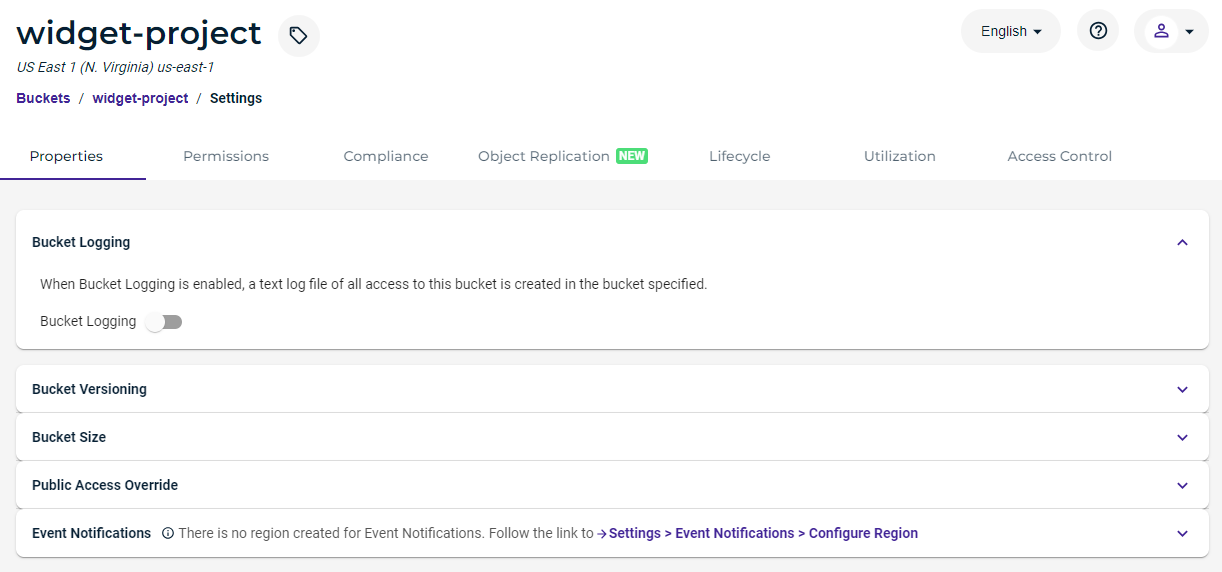
Slide to enable the Enable Bucket Logging option:
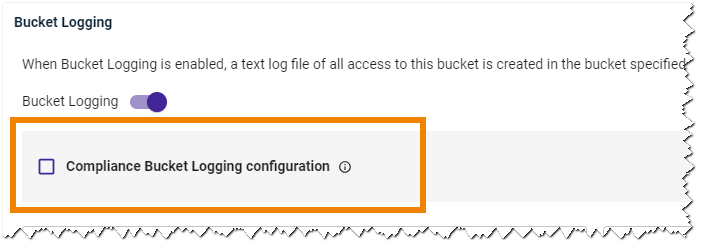
If Compliance Bucket Logging is enabled (Logging Settings in general Settings), you will see an option to create a comprehensive text log in a format designed to meet compliance needs.
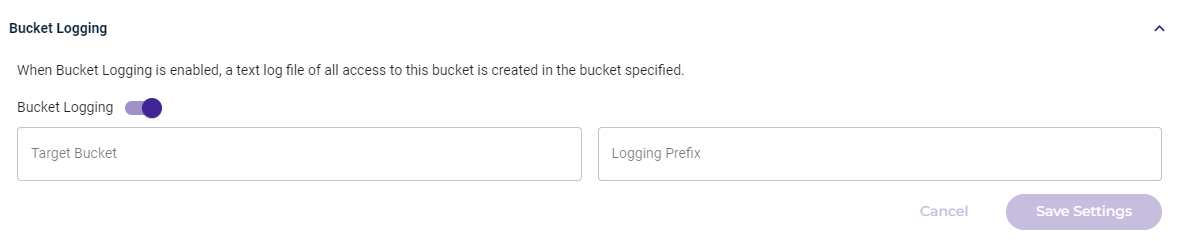
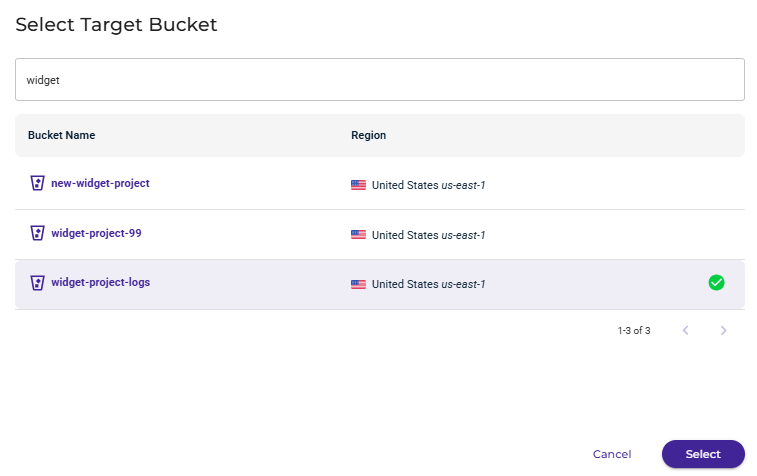
Click in the Target Bucket area and select the bucket in which to store log files. Then, click Select.
Enter a Logging Prefix to include in the log file name. Each log file will start with the characters you enter.
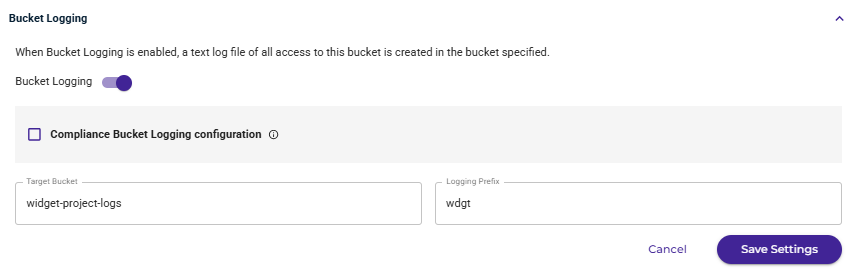
Click Save Settings to confirm your settings.
Reviewing a Bucket Log File
An example of a bucket log file is:
Record format: [BucketOwner Bucket Time RemoteIP Requester RequestId Operation Key Request-URI HttpStatus ErrorCode BytesSent ObjectSize TotalTime Turn-AroundTime Referrer User-Agent VersionId]
=========================================================================================================================================================
FB7994A8A908373EE038FB96D8EC045C6FA1D80910629A58D04ED2CAE3D6BA3A source-bucket [15/Feb/2026:20:53:15 +0000] 130.117.252.80 5EAF73AF483798F9C07D813CB274C6F1D0EB29DC512DE0980DBD8CD7D6A0DBCF E748D85F288E6E3A:A REST.PUT.OBJECT wasabi-manifest-2026-02-15--20-53-14.csv "PUT /source-bucket/wasabi-manifest-2026-02-15--20-53-14.csv" 200 - - 0 19 5 "" "Wasabi/Replicator" -
The record format includes:
BucketOwner—User ID of the source bucket, which is
FB7994A8A908373EE038FB96D8EC045C6FA1D80910629A58D04ED2CAE3D6BA3Ain the example above.Bucket—Name of the bucket for which an action was requested:
source-bucketTime—Time the request was received:
[15/Feb/2026:20:53:15 +0000]RemoteIP—Remote IP address of the requester:
130.117.252.80Requester—User ID of the person who requested the action on the bucket:
5EAF73AF483798F9C07D813CB274C6F1D0EB29DC512DE0980DBD8CD7D6A0DBCFRequestID—An auto-generated string that uniquely identifies the request:
E748D85F288E6E3A:AOperation—Operation that was requested:
REST.PUT.OBJECTKey—Object associated with the request:
wasabi-manifest-2026-02-15--20-53-14.csvRequest-URI—Part of the HTTP request message:
"PUT /source-bucket/wasabi-manifest-2026-02-15--20-53-14.csv"HttpStatus—HTTP status code of the request response:
200ErrorCode—S3 error response. A dash (
-) is displayed (as in the example above) if there was no error.BytesSent—The number of response bytes sent, excluding HTTP protocol overhead. A dash (
-) is displayed (as in the example above) if there were zero bytes sent.ObjectSize—Total size of the object:
0TotalTime—Number of milliseconds from the time the request was received to the time that the last byte of the response was sent:
19Turn-AroundTime—Number of milliseconds from the time the last byte of the request was received until the time that the first byte of the response was sent:
5Referrer—Value of the HTTP Referer header, if present. HTTP user-agents such as browsers typically set this header to the URL of the linking or embedding page when making a request. When a Referrer is not present,
""is displayed (as in the example above).User-Agent—Value of the HTTP User-Agent header:
"Wasabi/Replicator"VersionID—Version ID in the request. A dash (
-) is displayed (as in the example above) if there was no version ID.